
Description
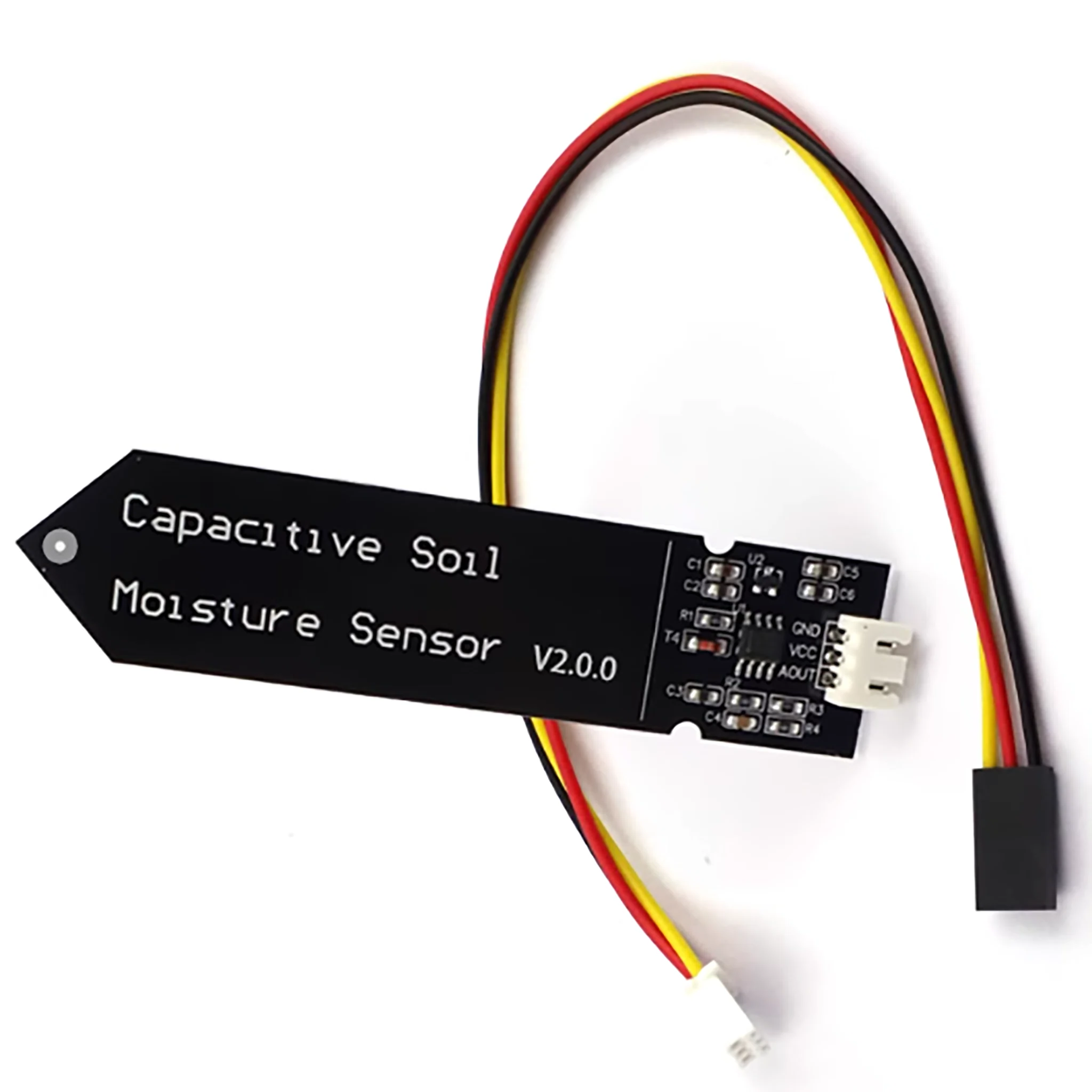
These sensors measure the volumetric water content of soil using the dielectric permittivity of the surrounding medium. As the water content in the soil changes, the dielectric constant changes, which alters the capacitance of the sensor’s internal circuit.
Key Advantages
-
Corrosion Resistance: The electronics are coated/enclosed, preventing the metal electrodes from oxidizing (a major failure point for resistive sensors).
-
Accuracy: They provide stable analogue output readings across a range of soil moisture levels.
-
Longevity: Due to the lack of direct electrical contact between the current and the soil, they last significantly longer in permanent installations.
Technical Specifications
Most common modules (like the generic v1.2/v2.0 capacitive sensors) operate based on the following general parameters:
| Feature | Typical Value |
| Operating Voltage | 3.3V to 5.5V DC |
| Output Signal | Analog (0V to Operating Voltage) |
| Interface | 3-pin JST connector (VCC, GND, Signal) |
| Dimensions | ~98mm x 23mm |
Implementation Guide
To integrate these into a project (e.g., using an Arduino, ESP32, or Raspberry Pi), follow these steps:
-
Calibration (Critical):
-
Air Value (Dry): Measure the sensor value while it is suspended in the air.
-
Water Value (Wet): Measure the sensor value while it is submerged in a cup of water.
-
Note: The values are inverted. A lower voltage typically indicates wetter soil, and a higher voltage indicates dry soil.
-
-
Mapping: Use the map (
)function in your code to convert the raw analogue reading (typically 0–1023 for 10-bit ADCs) into a user-friendly percentage (0% to 100%). -
Placement: Insert the sensor into the soil up to the indicated “max” line. Avoid hitting rocks or air pockets, as these will cause inaccurate, fluctuating readings.
Quick Troubleshooting Tips
-
Fluctuating Readings: Ensure your power source is stable. Capacitive sensors are sensitive to noise on the 3.3V/5V rails. Adding a capacitor across the VCC and GND pins can help stabilize readings.
-
Sensor Oxidation: Even though they are “corrosion resistant,” if the protective coating is scratched, moisture can eventually reach the traces. Inspect the board periodically if used in highly acidic or saline soils.
-
Soil Type: Different soil compositions (e.g., potting mix vs. garden clay) have different dielectric properties; always calibrate for the specific soil your project uses.
Reviews
There are no reviews yet.